AI for Kids by Age:
Wondering when kids should start using AI? This stage-by-stage guide explains what’s actually appropriate at ages 5, 8, 12, and 15 — including what tools help learning and what habits to avoid.


What's Actually Right at 5, 8, 12, and 15
"My daughter is 7 — is she too young for AI?"
"My son just turned 12 and his school is using ChatGPT. Should I be worried?"
"At what age should I actually start introducing this stuff at home?"
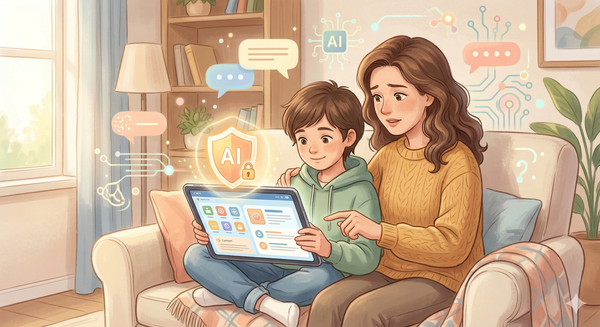
These are exactly the right questions. And the fact that you're asking them already puts you ahead of most parents — because the default in most households right now is either total restriction or total access, with very little in between.
The truth is more nuanced and more hopeful than either extreme. AI is not a monolith. A 5-year-old's relationship with AI should look completely different from a 15-year-old's. The tools are different. The goals are different. The risks are different. And the opportunities are different.
This guide is designed to be the one resource you bookmark, share, and return to as your child grows. We've broken it down by four key developmental windows — not just ages, but stages — because what matters isn't the number on the birthday cake. It's where your child is cognitively, emotionally, and socially.
Let's go stage by stage.
A Quick Note Before We Start: The Two Questions That Matter Most
Before any specific age recommendation, every parent should ask two questions about any AI tool they're considering for their child:
- Does this tool require my child to think — or does it think for them?
- Does this tool keep my child safe, and do I have visibility into how they're using it?
These two questions cut through the noise of every app review, every school recommendation, and every tech trend. If an AI tool passes both — it's worth exploring. If it fails either — proceed with caution regardless of what age it claims to serve.
Keep these questions in your back pocket as you read through each stage.
Stage 1: Ages 4–6 — The Wonder Window
What's Happening in the Brain
Children in this stage are in what developmental psychologists call the preoperational stage. Their thinking is imaginative, symbolic, and deeply egocentric — in the best possible way. They learn through play, storytelling, repetition, and sensory experience. They cannot yet think logically about cause and effect in complex systems, which means they genuinely cannot understand what AI is or how it works.
And that's completely fine. They don't need to.
What they need is to remain curious, creative, and comfortable with technology as a tool — not a companion, not an authority, and not a source of answers.
What Works at This Age
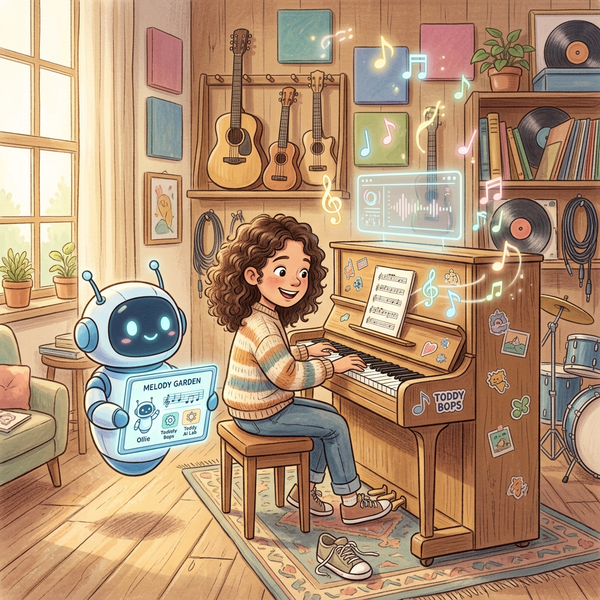
- AI-enhanced music and creativity apps — Tools where AI generates age-appropriate, joyful, educational music that kids respond to physically and emotionally. Movement, rhythm, and song are how this age group learns best.
- Voice-based storytelling tools — Apps that let children speak a character or a scenario and hear a story unfold. The child is the director; the AI is the storybook. This builds narrative thinking without screen dependency.
- Interactive read-aloud tools — AI that reads with expression, pauses for comprehension questions, and adapts pace to the child. This supplements — never replaces — reading with a parent.
What to Avoid at This Age
- Any open-ended chatbot or AI assistant (including asking Alexa or Siri complex questions unsupervised)
- AI tools that generate images based on child prompts — the outputs are unpredictable
- Educational AI apps that reward speed over process — this age group needs to linger and explore, not race to correct answers
The Parent's Role at This Stage
You are the filter. Every AI interaction at this age should happen with you present or with a tool you've fully previewed. The question to ask yourself isn't "is this educational?" It's "does this spark my child's imagination without replacing it?"
Stage 2: Ages 7–9 — The Builder Stage
What's Happening in the Brain
This is the stage Piaget called concrete operational thinking. Children can now understand cause and effect, follow multi-step instructions, and begin to think logically about the world around them. They are also deeply motivated by mastery — they want to be good at things, and they notice when they're improving.
This is a powerful window for introducing the concept of prompting — the idea that how you talk to AI changes what it gives you back. Children this age grasp this intuitively and find it genuinely exciting.
What Works at This Age
- Structured AI creativity tools — Platforms where children give AI a starting point (a character, a setting, a problem) and collaborate on a story, drawing, or game. The child leads; AI responds.
- AI-assisted reading comprehension tools — Tools that ask children questions about what they've read rather than summarizing it for them. The AI as questioner, not answer-giver.
- Introductory coding with AI concepts — Platforms like Scratch that introduce the logic of how programs (and by extension, AI) work. Not AI itself, but the foundational thinking that makes AI literacy possible.
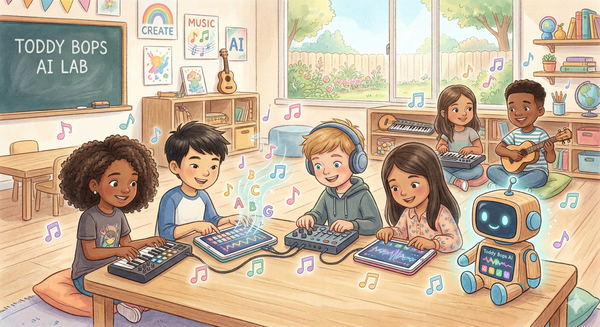
- Supervised AI music and art creation — Letting a child describe what they want and experiencing what AI generates. Then discussing: Is this what you imagined? What would you change? This is creative direction at an age-appropriate level.
What to Avoid at This Age
- AI homework helpers — this age group is in the critical window for building foundational academic skills. AI shortcuts here are particularly damaging to long-term learning.
- Open chatbots without parental controls or content filtering
- AI tools with social or community features — this age group is not ready to navigate AI-generated social dynamics
The Parent's Role at This Stage
Sit with them. Not to supervise — to explore together. Ask "what do you think will happen if we ask it this way instead?" You're teaching them that AI is responsive to human direction. That lesson, planted here, becomes the foundation for everything that follows.
Stage 3: Ages 10–13 — The Critical Thinking Window
What's Happening in the Brain
Children in this stage are entering formal operational thinking — the ability to reason abstractly, consider hypotheticals, and think about their own thinking (metacognition). They're also entering the social identity formation years, which means peer influence on tech habits is at its peak.
This is the age group most likely to discover ChatGPT through a friend. Most likely to use it for homework without telling you. And most likely to slide into what we call the Answer Trap — the gradual outsourcing of thinking to AI — if guardrails aren't in place.
It's also the age group with the most to gain from structured, intentional AI use.
What Works at This Age
- The Socratic Command — Teach your child to open every AI homework session with: "I am working on [subject]. Do not give me the answer. Ask me one question at a time to help me figure it out myself." This single habit transforms AI from shortcut to tutor.
- AI for research scaffolding — Using AI to generate questions about a topic, not answers. "What are the most important questions I should be able to answer about the Civil War?" Then finding the answers themselves.
- Fact-checking exercises — Giving AI a prompt, receiving an answer, and verifying it through independent sources. This builds the critical habit of never accepting AI output at face value.
- Creative AI collaboration — Writing stories, designing games, creating music or art with AI as a creative partner. At this age, children can direct AI with genuine sophistication.
- AI literacy discussions — Age-appropriate conversations about how AI works, where it gets its information, and why it sometimes gets things wrong. Give them vocabulary: prompting, training data, hallucination, bias.
What to Avoid at This Age
- Unsupervised access to open-ended AI chatbots for academic work without the Prompt Shield rules in place
- AI image generators without content filters — outputs can be unpredictable and age-inappropriate
- AI tools that generate social content (captions, messages, personas) — at this identity-forming stage, outsourcing self-expression to AI has real developmental consequences
The Parent's Role at This Stage
This is the stage to have the real conversation — not about rules, but about philosophy. What's the difference between using a tool and being used by one? What does it mean to think for yourself? Children 10–13 are ready for these questions and hungry for parents who take them seriously.
Stage 4: Ages 14–16 — The Orchestrator Window
What's Happening in the Brain
The prefrontal cortex — responsible for judgment, planning, and impulse control — is still developing but significantly more capable than in earlier stages. Teenagers can now engage in genuine strategic thinking about AI: not just "how do I use this tool" but "when should I use this tool, and when should I not?"
They're also making real decisions about their academic and professional future. AI literacy at this stage isn't just developmental — it's vocational.
What Works at This Age
- AI-assisted research and writing with full transparency — Using AI as a research accelerator, outline generator, and editing partner — while maintaining full authorship of the final work. The test: can your teenager explain and defend every argument in their essay without AI? If yes, they've used it well.
- Building with AI — Creating AI-assisted projects: a podcast, a small business plan, a designed product, a coded tool. Teenagers who have built something with AI understand it in a way no classroom can replicate.
- Prompt engineering as a skill — Deliberately studying how to write better prompts, comparing results, and understanding why certain instructions produce better outputs. This is a genuinely marketable skill right now.
- AI ethics exploration — Deep engagement with questions about AI bias, data privacy, intellectual property, and societal implications. Teenagers can handle complexity, and these conversations shape the adults they're becoming.
- AI for career exploration — Using AI tools to research fields, simulate interviews, draft professional communications, and explore what different careers actually involve day-to-day.
What to Avoid at This Age
- Using AI to generate college application essays — not just because it's dishonest, but because the personal statement is one of the last guaranteed spaces where a teenager must find their own voice. Outsourcing it is a genuine loss.
- AI social media tools that generate personas, captions, or engagement strategies — identity formation at this stage requires authentic self-expression, not optimized performance.
- Over-reliance on AI for emotional processing — some teenagers are beginning to use AI chatbots as therapists or confidants. This deserves a direct, non-judgmental parent conversation.
The Parent's Role at This Stage
Step back — but stay curious. Your teenager doesn't need you to manage their AI use anymore. They need you to ask good questions. What did you use AI for this week? What did it get wrong? What did you have to fix? What could you not have done without it? These conversations signal that you take their developing expertise seriously.
The One Thing That Matters at Every Age
Across every stage — from the 5-year-old dancing to AI-generated music to the 15-year-old building their first AI-assisted project — one principle holds constant:
Your child's mind should always be the most powerful thing in the room.
AI is a tool. An extraordinary, unprecedented, genuinely transformative tool. But a tool nonetheless. The families who understand this — who build children who can direct AI, question AI, improve AI, and when necessary, ignore AI — are raising the generation that will shape what comes next.
That's not a small thing. And it starts with the question you're already asking: What's right for my child, right now?
The fact that you're asking it means you're already ahead.
Related Reading at Toddy Bops AI:
- The Answer Trap: AI Homework Help Dangers and the Hidden Risk to Your Child's Critical Thinking
- The AI Fluency Ladder: 5 Levels Every Child Will Move Through
- Prompting 101: How to Talk to AI So It Actually Helps You
- The Orchestrator Mindset: The Most Important Thing You Can Teach Your Child About AI (coming soon)