Apple's CEO Just Said Something Every Parent of a Creative Kid Needs to Hear
Apple CEO Tim Cook just made a powerful statement about AI, kids, and creativity — and it’s something every parent needs to hear right now.

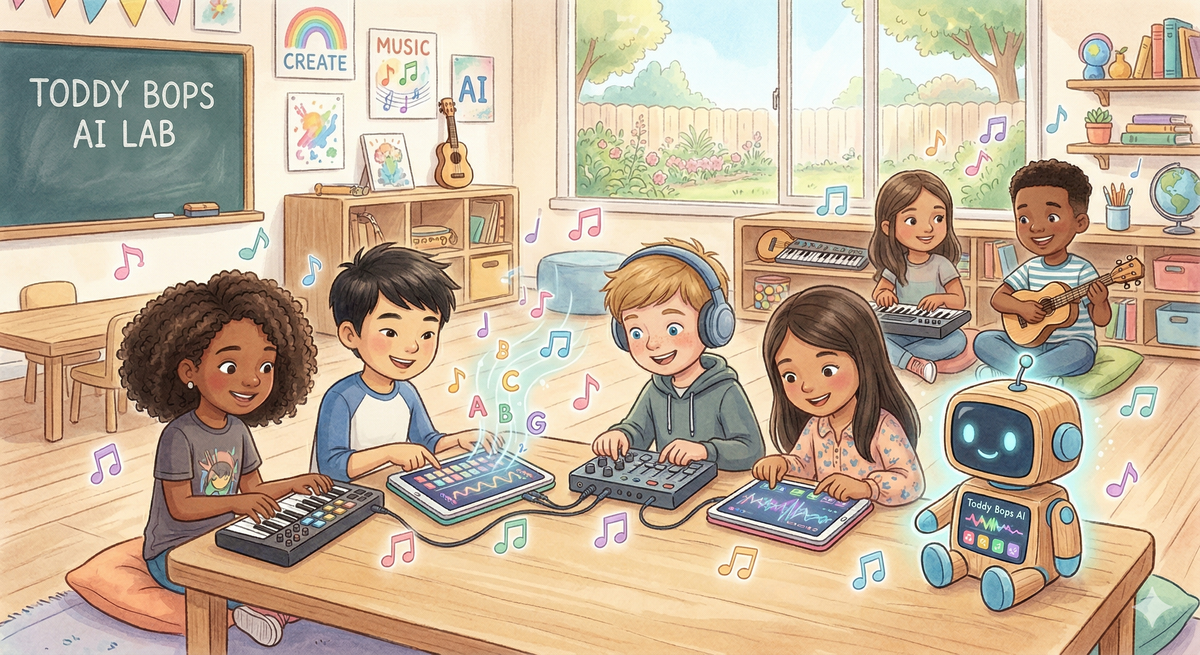
Tim Cook's GMA interview this week wasn't just about Apple. It was about what happens to creativity — and children — when technology gets the relationship with humans wrong.
On Monday, March 17th, Apple CEO Tim Cook did something unusual for a tech executive.
He didn't unveil a product. He didn't announce a platform. He didn't talk about market share or quarterly earnings or the next operating system release.
He went to a public school in Harlem and watched children make music.
The visit to Wadleigh Secondary School for the Performing and Visual Arts — where students used iPads and Apple Pencils to compose and produce original tracks alongside singer-songwriter Maggie Rogers — was the backdrop for Cook's Good Morning America interview with Michael Strahan. And what Cook said in that interview, in the middle of Apple's 50th anniversary celebration, deserves more attention from parents than the tech press has given it.
Not because of what he said about Apple. Because of what he said about AI, about screens, and about what children actually need right now.
And because of what his actions — not just his words — signal about where the most forward-thinking voices in technology think we need to go.
What Tim Cook Actually Said — And Why It Matters
Cook made three statements in the GMA interview that every parent should sit with. They didn't come from a parenting expert or a child development researcher. They came from the CEO of the most valuable technology company in the world — someone who has spent decades thinking about the relationship between humans and technology.
On AI
This is not a corporate disclaimer. It is a genuinely important philosophical position — and it aligns precisely with everything we teach at Toddy Bops AI.
Technology is neutral. AI is neutral. What determines whether it serves children or harms them is not the tool itself — it is the intention, the design, the guardrails, and most importantly the habits of the human using it. A child who has been taught to direct AI, to question its outputs, to use it as a thinking partner rather than an answer machine — that child has a fundamentally different relationship with the same tool than a child who has been handed it without context or guidance.
Cook's point is the Orchestrator Mindset stated from one of the most influential positions in the technology industry. The tool is only as good as the human wielding it. Which means the most important thing we can invest in is not better tools — it is better-prepared children.
On Screen Time
Pause on this for a moment. The CEO of the company that makes the iPhone — a product used by over a billion people — is telling parents not to let their children use it too much.
This is not performative. Cook has said versions of this before, and Apple has built Screen Time tools directly into iOS for years. But hearing it stated this plainly, this week, in the context of a visit to a school where children are creating rather than consuming — it lands differently.
The distinction Cook is drawing is one that parents intuitively understand but rarely see articulated by tech leaders: there is a profound difference between technology that produces something and technology that passively consumes your attention. A child scrolling a feed is being used by technology. A child using an iPad to compose music is using technology to express something that exists nowhere else — in no algorithm, in no training data, in no model. It exists only in them.
On Creativity and Apple's Legacy
When Cook was asked about Apple's most important contributions over 50 years, he didn't lead with profits or market dominance. He led with creativity — with music, with the arts, with bringing creative tools to people who didn't previously have access to them.
That framing is important for parents to notice. The company that built the most successful technology products in history believes its legacy is about enabling human creativity. Not replacing it. Enabling it.
Save The Music: What It Is and Why the Expansion Matters Right Now
The centerpiece of Cook's Harlem visit was Apple's expanded partnership with Save The Music Foundation — and the timing of this announcement is not incidental.
Apple's expanded partnership will bring music programming to nearly 50 additional schools, reaching approximately 25,000 students with music education next year — nearly double the previous reach. Students at partnered schools receive not just instruments but Apple devices specifically configured for music creation: iPads, Apple Pencils, and the kind of production tools that professional musicians use.
The students Cook visited at Wadleigh weren't practicing scales or reading sheet music in the traditional sense. They were producing. Composing. Creating original work using technology as a creative instrument rather than a consumptive one.
Why the Timing Is Critical
This expansion is happening against a backdrop that parents — especially those in public schools — need to understand clearly.
Arts and music programs are disproportionately vulnerable to budget cuts. They have always been the first casualties when school funding tightens. And in the current federal education climate, with arts education being systematically deprioritized at the policy level, the programs that have survived are under fresh pressure.
The Save The Music expansion is Apple putting significant resources into a specific belief: that music education is not an extracurricular luxury. It is a fundamental component of what children need to develop — cognitively, emotionally, and creatively — in a world that is increasingly automated.
That belief has substantial research behind it. Children who participate in music education show stronger performance in reading and mathematics. They develop greater emotional regulation, stronger memory, and more sophisticated pattern recognition. They build the capacity for sustained focused attention — the same capacity that is most threatened by the dopamine-optimized scroll of social media and the frictionless answer delivery of AI tools used without intention.
Why This Story Is Bigger Than Apple
Cook's GMA interview and the Save The Music expansion are, on the surface, a positive tech-company-does-good story. But there are three threads running through it that connect directly to the conversations parents need to be having right now.
Thread 1: Creativity Is a Human-Only Skill — And It Needs Protection
At Toddy Bops AI, we talk about Human-Only Skills — the capabilities that AI cannot replicate regardless of how sophisticated it becomes. Lived experience. Genuine emotional expression. Original creative intuition. The specific, unrepeatable combination of influences that makes a particular person's voice their own.
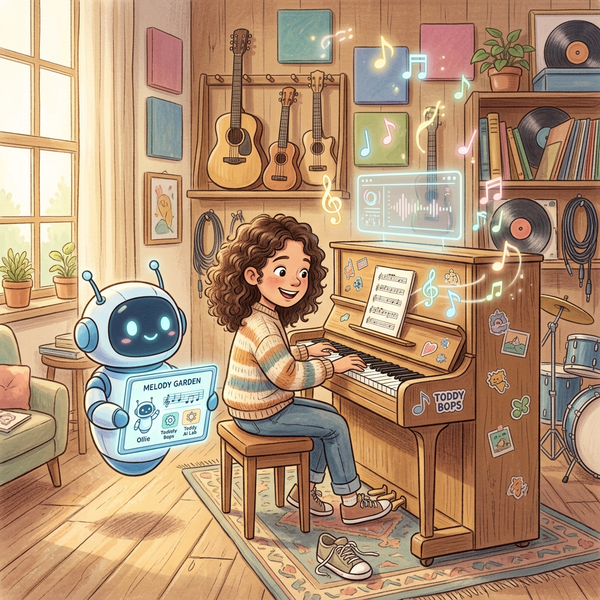
Music is one of the purest expressions of Human-Only Skills in existence. When a child composes a melody, they are drawing on every experience they've ever had, every emotion they've felt, every sound that has moved them. An AI can generate music that sounds like music. It cannot generate music that sounds like that specific child's interior world.
The children at Wadleigh that Cook visited weren't just learning music. They were practicing being irreplaceable. And in a world where AI is becoming capable enough to automate vast categories of cognitive work, that practice is not optional. It is essential.
Thread 2: The Most Dangerous Thing About AI Is Passive Consumption
Cook's comment about not wanting people to scroll endlessly — to consume rather than create — points to what researchers increasingly identify as the core risk of AI and digital technology for children: passivity.
A child who is always receiving — content, answers, entertainment, stimulation — is a child whose generative capacity is quietly atrophying. The ability to begin something from nothing. To tolerate the discomfort of a blank page. To push through the frustrating early stages of learning a skill before it becomes rewarding.
These capacities are not guaranteed. They are developed through practice — specifically through the practice of making things, struggling with things, and finishing things. Music education is one of the most rigorous and rewarding forms of that practice available to children. The fact that it is being cut from schools at exactly the moment when children most need protection for their generative capacities is not a coincidence. It is a crisis.
Thread 3: Technology Companies Can Be Allies — When They Choose To Be
It is worth naming something that Cook's actions this week represent, because it runs counter to a narrative that parents sometimes carry: that technology companies are uniformly and inevitably working against children's wellbeing in pursuit of engagement and profit.
That narrative is not entirely wrong. There are documented cases of technology companies designing products specifically to maximize children's screen time at the expense of their development, their sleep, and their mental health. Those concerns are real and warrant real vigilance.
But Cook's interview and the Save The Music expansion represent something different: a technology company choosing to use its resources to protect and expand the human creative capacities that its own products, used wrongly, could undermine. That choice deserves acknowledgment — and it deserves the attention of parents who are trying to figure out which technology companies to trust with their children's lives.
What This Means for Your Child — Practically
This is a news story. But it has direct implications for decisions parents can make right now. Here's what we'd encourage you to take away.
Find Out If Your Child's School Has Music
Not all schools do. And in many districts, music programs exist on paper but have been hollowed out by funding cuts — minimal instruction time, outdated instruments, teachers stretched across multiple schools.
Ask your child's school directly: what does music education look like here? How many students have access to it? Is it funded or at risk? The answer will tell you a lot about what your child is getting and what they might be missing.
If Your School Doesn't Have Music — Save The Music Is a Resource
Schools in underserved districts can apply for grants through the Save The Music Foundation directly. The grants provide instruments, technology, teacher training, and ongoing program support — not a one-time donation but a sustained investment in a functional music program.
If your child's school is struggling to maintain its music program, or doesn't have one, Save The Music's website (savethemusic.org) has grant information and application guidance. This is a resource worth knowing about and sharing with school administrators and parent organizations.
Think About Creativity as Part of Your Child's AI Preparation
This is perhaps the most important practical takeaway from this week's story. As you think about preparing your child for the AI era — and if you've been reading Toddy Bops AI, you're thinking about this — don't let the conversation stay entirely in the domain of AI tools and digital literacy.
The children who will navigate the AI era most successfully are the ones who have a strong, practiced relationship with their own creative and generative capacities. They make things. They struggle through the learning curve of a skill. They know what it feels like to produce something that came from inside them rather than from a tool.
Music is one path to that. Art is another. Writing. Cooking. Building. Any creative practice that requires sustained effort, tolerates failure, and produces something original is building the same foundational capacity.
The Bigger Picture: What Cook's Visit to Harlem Signals
Apple's CEO didn't have to spend part of his company's 50th anniversary in a public school in Harlem watching students make music. He had a hundred more conventionally impressive ways to mark that milestone.
He chose this.
And whether you read that as genuine conviction or savvy brand positioning — or both — the statement it makes is worth taking seriously: in the middle of the most significant technological transition in a generation, one of the most powerful people in the technology industry is investing in children's capacity to create.
Not to consume. Not to interact with AI. Not to be more productive or more efficient or more college-ready.
To make music. To express something. To be, in the most fundamental sense, irreplaceable.
That is a message worth carrying home from Harlem.
What You Can Do This Week
- Ask about music at your child's school. Find out what's available, what's funded, and what's at risk.
- Share this story with your school's PTA or parent organization. The Save The Music grant program is a real resource that many schools don't know about.
- Look up savethemusic.org. If your school needs music program support, the application process is straightforward. Share it with an administrator.
- Make something with your child this week. Cook. Build. Draw. Play an instrument. Write a story together. Practice being the kind of family that makes things — not just consumes them.
- Keep building AI readiness AND creative capacity. These are not competing priorities. They are the same priority. The child who creates is the child who will direct AI rather than be directed by it.
Related Reading at Toddy Bops AI:
- The Orchestrator Mindset: The Most Important Thing You Can Teach Your Child About AI
- The Answer Trap: Why Your Child Needs to Struggle — and How AI Can Make That Harder
- AI for Kids by Age: What's Actually Right at 5, 8, 12, and 15
- Is Your Teenager Talking to an AI Friend? What Every Parent Needs to Know
- Why Music Education Is the Best Preparation for the AI Era — And How to Fight for It in Your Child's School (Coming Soon)