My Kid Thinks AI Homework Help Is Fine.
Teenagers are adopting AI faster than parents understand it. Bridging the AI divide inside your family may be one of the most important conversations you have.


I Don't. Who's Right?
The Parent-Teen AI Divide Is Real, Growing, and More Nuanced Than Either Side Thinks
It starts at the kitchen table.
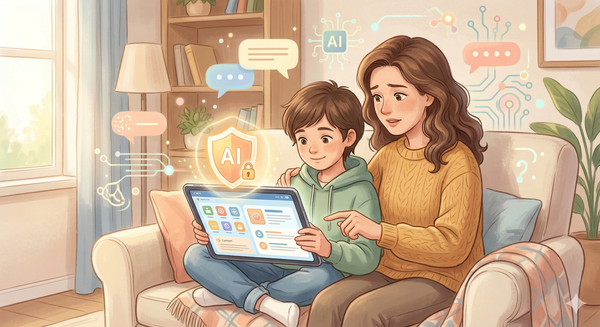
Your teenager is working on an essay. You glance over and see a tab open — ChatGPT, or maybe Gemini, or the AI built into their school's learning platform. They're copying something. Or editing something the AI generated. Or asking it to rewrite a paragraph they just wrote.
You say something. They push back.
"Everyone does it."
"My teacher knows we use it."
"It's just a tool, like a calculator."
"You used spell-check. How is this different?"
And here's the uncomfortable truth that no one tells parents: some of what your teenager is saying is correct. Some of it is self-serving rationalization. And the line between those two things is less obvious than either of you probably realizes.
This article is about that line. Not to settle the argument definitively — nobody can, because this is genuinely new territory — but to give both sides of your kitchen table a clearer, more honest framework for thinking it through.
Because "who's right" is the wrong question. The right question is: what kind of relationship with AI actually serves your child's future?
First, the Data: What's Actually Happening
Before the argument, the facts. Because a lot of the parent-teen AI debate is happening without them.
The gap between how teenagers experience AI and how their parents experience it is not just generational preference. It reflects a genuinely different relationship with the technology.
Teenagers have grown up with AI already woven into their lives — in their search results, their social media feeds, their music recommendations, their autocomplete. For them, using AI for a homework task doesn't feel categorically different from Googling something. It's just a faster, more capable version of a tool they've always had.
Parents, meanwhile, remember a world where the work was the work. Where writing an essay meant writing an essay — struggling with the opening, crossing out sentences, finding your argument through the act of making it. The idea that a machine can do that work feels like it skips something essential. Because it does. The question is: what exactly does it skip, and does that matter?
The Case Your Teenager Is Making — and Why Parts of It Are Valid
Let's be honest: teenagers aren't wrong about everything here. Their arguments deserve a fair hearing before we dismiss them.
"It's just a tool, like a calculator."
The calculator analogy is the most common argument teenagers make — and it's not entirely wrong. When calculators entered classrooms in the 1970s, there was real debate about whether they were cheating. We now accept them as standard tools, partly because we decided that calculating quickly matters less than understanding what to calculate and why.
The teenager's point has merit: the line between "tool" and "cheating" has always been drawn by adults making judgment calls about what skills need to be developed through struggle. Those judgment calls were not always right. History has revised them before.
Where the analogy breaks down: a calculator performs a discrete, narrow operation — arithmetic — that was always separate from the conceptual understanding it assists with. AI can generate the entire essay, construct the argument, supply the evidence, and write the conclusion. It doesn't assist with a narrow operation. It can replace the entire cognitive task. That's a qualitatively different kind of tool.
"My teacher knows we use it."
This one is often true and parents need to reckon with it. School AI policies vary enormously — between districts, between schools, between individual teachers, and between assignments. In many classrooms right now, AI-assisted work is permitted, expected, or even required. Your teenager may genuinely be following the rules.
Where it gets complicated: school policy and developmental wisdom are not the same thing. A teacher allowing AI use is making a decision about classroom management and academic integrity — not necessarily about what best serves your child's long-term cognitive development. Schools are figuring this out in real time, just like everyone else. "My teacher allows it" is not the same as "it's definitely good for me."
"Everyone does it."
This one contains a real tension that parents often underestimate. The competitive pressure teenagers feel around grades, class rank, and college applications is genuine and intense. When AI use becomes widespread in a classroom, opting out can feel like unilateral disarmament.
This doesn't make it right. But it makes it understandable — and it means that telling your teenager to simply not use AI, without addressing the underlying pressure, is an incomplete response.
The Case Parents Are Making — and Why Parts of It Are Also Valid
Now the other side. Because the parental instinct here is not just nostalgia or technophobia. There are real, research-backed concerns underneath it.
"You're not actually learning anything."
This is the strongest argument in the parental case, and the research backs it up completely. Learning requires struggle. Cognitive science is unambiguous on this: the effort of generating, retrieving, and wrestling with information is the mechanism by which it becomes durable knowledge.
When AI removes that struggle, the output may look identical — the essay gets an A — but the internal development it represents is absent. Your teenager can produce great-looking work without developing the capability to produce it. And that gap will be visible the moment the tool isn't available: in a timed exam, a job interview, a college application essay written in a supervised room.
"This is the most important skill-building time of your life."
Also valid. Adolescence is not just a holding period before adult life. It is a critical developmental window where the brain is building the cognitive infrastructure it will use for the next 60 years. The habits of mind formed now — the willingness to wrestle with hard problems, the ability to start from nothing, the confidence to hold and defend a position — are not things that can be built later with the same ease.
Parents who sense that something essential is at stake are not wrong. They may not have the vocabulary to articulate exactly what it is. But the instinct is sound.
"I don't know what you're submitting under your name."
This one is worth taking seriously at a level beyond academic integrity policies. The habit of putting your name on work you didn't do — of performing competence rather than building it — has consequences that extend beyond school. It shapes how a person relates to their own abilities, their own reputation, and their own sense of what they're capable of.
A teenager who learns that outputs matter more than process is learning something about character that will show up in their adult life in ways that have nothing to do with homework.
Where Both Sides Are Getting It Wrong
Here's what neither side typically says — but both need to hear.
Where parents get it wrong
Blanket bans don't work and they miss the point. If you tell your teenager they cannot use AI at all — full stop, no exceptions — you are not preparing them for the world they are entering. AI is going to be in their college classes, their internships, their workplaces, their creative lives. The parent who raises a child with zero AI experience is not protecting them. They are disadvantaging them.
The goal is not AI abstinence. It is AI wisdom. And wisdom cannot be developed through prohibition. It has to be developed through guided practice, reflection, and increasingly independent judgment.
Where teenagers get it wrong
"Everyone does it" and "my teacher allows it" are not the same as "it's good for me." The fact that a behavior is widespread does not make it developmental sound. The fact that an adult permits something does not mean it serves your long-term interests.
Teenagers who use AI to avoid the struggle of thinking are not just bending a rule. They are short-changing themselves. The confidence, the voice, the intellectual independence that comes from doing hard cognitive work — from writing a bad first paragraph and then a better one and then one you're actually proud of — cannot be borrowed from a machine. It has to be earned.
And a teenager who reaches college, or a job, or a moment that genuinely matters, and discovers they cannot perform without AI assistance, will feel the cost of those shortcuts in a way that no grade ever prepared them for.
The Framework That Actually Resolves This: Use vs. Outsource
Stop arguing about whether AI is allowed. Start asking a better question:
Did my child use AI — or did AI use my child?
This is the distinction that cuts through every argument at the kitchen table. Not "did you use AI" but "who was doing the thinking?"
AI Use (Healthy)
- Your teen wrote a draft first, then asked AI to suggest improvements
- Your teen used AI to explain a concept they didn't understand — then applied that understanding themselves
- Your teen asked AI to challenge their argument and used the pushback to strengthen it
- Your teen used AI to check grammar and flow after the thinking was already done
- Your teen can explain, defend, and expand on every idea in their submitted work
AI Outsourcing (The Problem)
- Your teen opened AI before attempting the task themselves
- Your teen submitted AI-generated text with minimal editing or engagement
- Your teen cannot explain the argument in their own essay without referring back to the AI output
- Your teen uses AI to avoid the discomfort of not knowing where to start
- Your teen's "voice" in written work sounds nothing like how they actually speak or think
How to Have This Conversation Without It Becoming a Fight
The kitchen table argument usually fails because both sides feel unheard. Here's a structure that actually works.
Step 1: Acknowledge what they're right about
Start by saying something you genuinely mean: "I think you're right that AI is going to be part of your life and your career. I'm not trying to pretend it doesn't exist or that you shouldn't learn to use it. I actually want you to be really good at it."
This is not a manipulation tactic. It is true. And it changes the entire dynamic of the conversation that follows — from adversarial to collaborative.
Step 2: Name your actual concern
Not: "AI is cheating." Not: "You're being lazy."
Try: "My concern isn't the tool. My concern is whether you're still doing the thinking. Because the thinking is what builds you — not the output."
Most teenagers, when they hear this framing, recognize it as fair. They may not agree immediately. But they can engage with it in a way they cannot engage with blanket rules.
Step 3: Build the agreement together
Don't hand them a policy. Build one together. Ask:
- "What do you think you should always do yourself, without AI?"
- "What do you think AI is genuinely useful for in your schoolwork?"
- "How would you know if you were relying on it too much?"
Teenagers who participate in building the rules are dramatically more likely to follow them. And the conversation itself — thinking through the ethics of AI use with a parent who takes them seriously — is one of the most valuable things you can give them.
The Bigger Point Nobody Is Making
The parent-teen AI debate is happening in almost every household with a teenager right now. But most of those arguments are about the wrong thing.
They're about rules, permissions, and policies. About whether this specific assignment was or wasn't okay. About whether the teacher allows it or the school prohibits it.
The conversation that actually matters is about something deeper: what kind of thinker do you want to be?
That question — asked genuinely, with curiosity rather than accusation — is one that most teenagers have never had the opportunity to answer. They've been told what to do about AI (use it, don't use it, cite it, don't cite it) without being invited to think about what they want their relationship with it to look like.
When you invite that conversation, something shifts. The teenager stops defending a behavior and starts examining it. The parent stops issuing rules and starts having an influence. And the kitchen table stops being a courtroom and starts being what it should be: the place where your family figures out hard things together.
The Parent's Quick Guide: Where to Draw the Line
- Always okay: Using AI to understand a concept, check grammar after writing, generate research questions to then answer yourself, or get feedback on a completed draft.
- Proceed with conversation: Using AI to help structure an outline, get a starting point for a stuck essay, or improve clarity of ideas already written.
- Worth a direct discussion: Using AI to generate the first draft, relying on AI for the opening when they feel stuck, or submitting work they can't fully explain.
- Non-negotiable: Submitting AI-generated work as their own without engagement, using AI specifically to avoid thinking, or being unable to discuss their own submitted work.
- The one rule above all others: Whatever AI helps produce, your child should be able to stand behind it, explain it, and defend it as genuinely representing their thinking. If they can't, something important was skipped.
Related Reading at Toddy Bops AI:
- The Answer Trap: AI Homework Help Dangers and the Hidden Risk to Your Child’s Critical Thinking
- The Orchestrator Mindset: The Most Important Thing You Can Teach Your Child About AI
- AI for Kids by Age: What's Actually Right at 5, 8, 12, and 15
- Is Your Teenager Talking to an AI Friend? What Every Parent Needs to Know About AI Companion Apps