The Socratic Classroom: How AI Is Changing the Way Teachers Teach
AI isn’t replacing teachers — it’s reshaping how they teach. Discover what AI-integrated classrooms really look like and what it means for your child at school and at home.

The loudest fear about AI in education is simple:
“Will teachers be replaced?”
The quiet truth is more interesting.
AI isn’t replacing teachers.
It’s reshaping what teaching feels like.
Across the country, federal grants and state initiatives are now prioritizing AI-integrated teacher training. The goal is not automation — it’s amplification.
The classroom of 2026 looks different. But not in the way many people imagine.
What Is an “AI-Integrated” Classroom?
It does not mean robots teaching children.
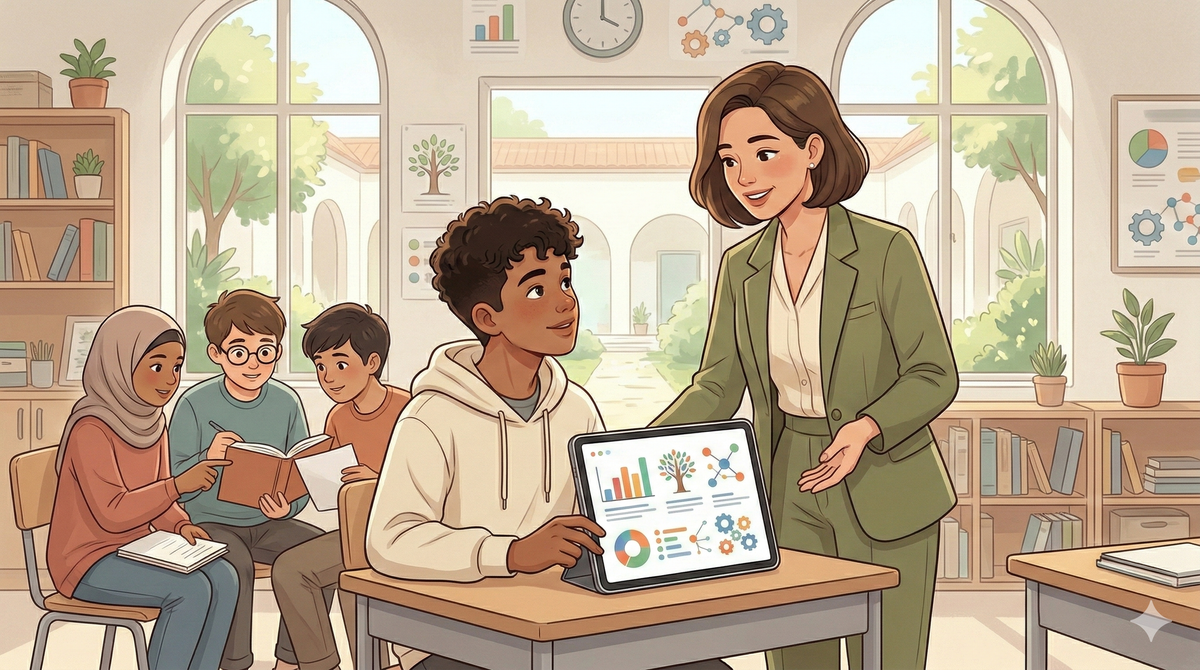
It means teachers using AI to:
• Reduce administrative workload
• Analyze student progress more quickly
• Identify learning gaps in real time
• Personalize instruction without burning out
For decades, teachers have had to manage 25–30 different learning speeds at once.
AI tools can now help surface patterns:
Who is struggling with fractions?
Who needs vocabulary support?
Who hasn’t mastered the concept — even if their test score looks fine?
This data doesn’t replace judgment.
It informs it.
The Return of Socratic Teaching
Ironically, AI may bring classrooms closer to something ancient: the Socratic method.
Instead of spending hours grading and formatting lesson plans, teachers can redirect time toward:
• Asking better questions
• Facilitating discussion
• Coaching critical thinking
• Encouraging reflection
When AI handles routine tasks, human instruction becomes more human.
Less clerical.
More relational.
What This Means for Your Child
Your child may soon experience:
• More personalized assignments
• Faster feedback loops
• Targeted practice
• AI-powered tutoring outside school hours
But here’s the important part:
The teacher remains the interpreter.
AI can detect patterns.
Teachers decide what those patterns mean.
The Hidden Benefit: Reduced Teacher Burnout
One of the least discussed aspects of AI integration is teacher sustainability.
Educators spend enormous time:
• Grading repetitive work
• Drafting administrative reports
• Tracking individual performance manually
AI-assisted systems can reduce this load.
And when teachers are less overwhelmed, students benefit.
Calmer teacher.
More focus.
Better classroom climate.
The Risk: Over-Reliance
There is a boundary here.
If AI becomes the primary explainer instead of a support layer, learning weakens.
That’s why training matters.
Responsible AI integration emphasizes:
• Transparency
• Ethical safeguards
• Data privacy
• Human oversight
The schools that get this right will treat AI as a support structure, not a substitute.
How Parents Can Stay Engaged
You don’t need to master the tools your child’s school is using.
You need to ask smart questions:
• How is AI being used in the classroom?
• Is it supporting instruction or replacing explanation?
• How is student data protected?
• What happens if a family opts out?
Curiosity builds trust.
Silence builds anxiety.
The Bigger Picture
Education has always evolved alongside technology.
Printing press.
Calculators.
Computers.
The internet.
Each innovation sparked fear.
Each ultimately reshaped the classroom.
AI is no different — but it is faster.
The goal isn’t resisting it.
It’s shaping it.
A Calm Perspective for Families
Your child’s teacher is still the adult in the room.
Still the guide.
Still the mentor.
AI may help identify learning gaps at 2:17 PM on a Tuesday.
But it cannot replace encouragement.
It cannot replace tone.
It cannot replace presence.
The Socratic Classroom is not a machine-run classroom.
It’s a classroom where teachers have better tools — and more time to think.
This is Part 3 of our White House AI in Schools series.
Part 1: AI Opt-Out Rights
Part 2: The AI-Ready Workforce
Part 4: (Coming soon) — How to Talk to Your School About AI Without Starting a Culture War