Why Critical Thinking Is the Most Important Skill Your Child Can Build in the AI Age
In a world where AI can generate answers instantly, critical thinking is becoming the most valuable skill your child can build. Here’s how to strengthen it at home.


Artificial intelligence can generate essays, solve equations, summarize books, and write code in seconds.
What it cannot do is think with conscience.
As AI becomes more powerful, the value of raw information is declining. Answers are cheap. Speed is automated. Execution is scalable.
But discernment — the ability to evaluate, question, and interpret information — is becoming priceless.
In the AI age, critical thinking is no longer an academic “nice to have.”
It is a survival skill.
The Skill That Machines Cannot Fully Replicate
AI models are trained on massive datasets. They predict patterns. They generate probabilities. They simulate reasoning.
But they do not:
• Experience consequence
• Hold moral responsibility
• Understand lived context
• Weigh nuance the way humans do
A child who can evaluate information — not just consume it — will always be ahead of the algorithm.
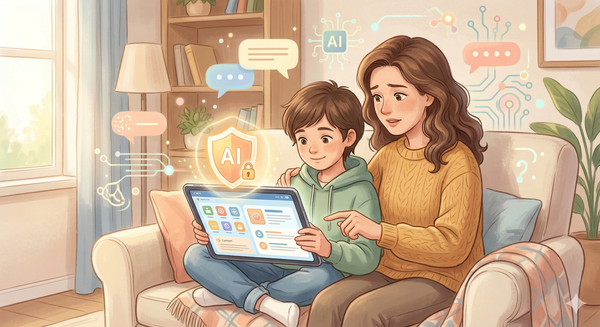
This is why many educators are shifting toward a more human-centered AI approach, where technology supports reflection instead of replacing it.
When we strengthen judgment and reasoning, we future-proof our children in ways no coding class alone can accomplish.
The Hidden Risk of “Answer Abundance”
In previous generations, children had to search for information.
Today, information searches for them.
When AI provides immediate responses, children may stop asking:
“Is this correct?”
“Who created this?”
“What perspective is missing?”
“What would I argue differently?”
This is where the danger lies.
Not in AI itself —
but in passive acceptance.
If you haven’t yet explored how instant-answer culture affects cognition, our article on The AI “Answer Trap” dives deeper into how productive struggle builds real intelligence.
Critical thinking is the antidote.
4 Ways to Build Critical Thinking at Home
You do not need a formal curriculum.
You need better questions.
1. Ask for Evidence
When your child makes a claim, gently ask:
“What makes you think that?”
This builds reasoning, not defensiveness.
2. Reverse the Argument
If they state a strong opinion, ask:
“What would someone who disagrees say?”
This develops cognitive flexibility.
3. Spot the Glitch
Have your child intentionally look for mistakes in AI-generated responses.
Children who can critique AI remain in control of it.
4. Delay the Answer
Before allowing AI to respond to a homework question, ask your child to write one sentence predicting the solution.
This primes their own neural pathways before external input influences them.
Why This Skill Compounds Over Time
A child who can:
• Define problems clearly
• Evaluate sources
• Question assumptions
• Integrate technical and human insight
Becomes the kind of person who directs AI — not depends on it.
This is the same principle we explored in The Ghost in the Cubicle, where we explain why orchestration will matter more than execution in the 2035 economy.
Critical thinking is the foundation of orchestration.
The Long Game
Technology will continue to evolve.
Models will get faster.
Outputs will get smoother.
Automation will get deeper.
But the premium will always belong to the child who can pause and ask:
“Is this right?”
“Is this ethical?”
“Is this complete?”
“What am I missing?”
That pause is power.
And it is teachable.
Ready to Strengthen Your Child’s Human Edge?
If you want practical tools to build reasoning skills at home, download our free 60-Second AI Safety Checklist — a simple guide to protecting privacy, preventing over-dependence, and modeling healthy AI use.
Or join the Toddy Bops AI community to access our growing library of family-ready frameworks designed to keep your child thinking boldly in an AI-powered world.
The future will reward thinkers.
Let’s raise them intentionally.