Why Music Education Is the Best Preparation for the AI Era —
In a world where AI can create music instantly, why should kids learn it? Because music education builds the exact human skills AI can’t replace.

And How to Fight for It in Your Child's School
Here is a question that sounds like it has an obvious answer — until you think about it seriously:
In a world where AI can generate a complete, professional-sounding song in under 30 seconds, why should children spend years learning to play an instrument?
The obvious answer is: they shouldn't. If the goal is music, AI is faster, cheaper, and infinitely more patient.
But that answer misunderstands what music education is actually for. And parents who accept it — or who allow school boards and budget committees to accept it — are making a mistake that will cost their children something that cannot be recovered later with an app or a subscription.
Music education is not primarily about producing musicians. It never has been. It is about producing humans who have practiced — at a deep, embodied, neurological level — the exact cognitive and emotional capacities that the AI era is placing under its greatest pressure.
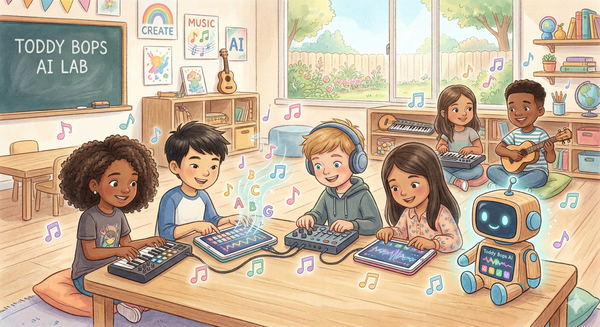
The children sitting in band rooms and choir rehearsals and music production classes right now are not preparing to compete with AI. They are practicing being something AI cannot be. And that practice is exactly what will make them valuable, adaptable, and genuinely capable in the world they are inheriting.
This article is about why that is true, what the research says, what is happening to music programs in schools right now, and what parents can do about it — specifically, practically, and starting this week.
What Music Education Actually Builds — The Science
The research on music education and child development is among the most robust in educational science. It spans decades, multiple countries, and dozens of independent research institutions. And it consistently points to the same conclusion: learning to make music changes the brain in ways that transfer powerfully to almost every other domain of learning and life.
But the specific capacities it builds are worth naming carefully — because in the context of the AI era, they are not just educationally valuable. They are strategically essential.
1. Sustained Focused Attention
Learning to play an instrument requires the brain to hold multiple streams of information simultaneously — reading notation, coordinating physical movement, listening to output, adjusting in real time — while maintaining focus over an extended period. This is not passive attention. It is active, directed, sustained cognitive engagement.
This capacity — for sustained focus in the face of complexity — is precisely what is most threatened by the attention economy. Social media is engineered to fragment attention into smaller and smaller units. AI tools that deliver instant answers remove the need to hold a problem in mind long enough to develop genuine understanding. Music practice rebuilds what the digital environment is quietly dismantling.
2. Tolerance for Productive Struggle
Music does not become beautiful quickly. It becomes beautiful slowly, through hundreds of hours of imperfect attempts, frustrating plateaus, and incremental progress that is often invisible to the learner in the moment.
A child learning a difficult piece on the piano is practicing something far more important than the piece: they are practicing the experience of being bad at something on the way to becoming good at it. They are building the emotional infrastructure to tolerate incompetence as a temporary state rather than a permanent identity.
This is the capacity that AI erodes most directly. When correct answers arrive in seconds, the tolerance for not-knowing — for sitting with difficulty and working through it — begins to atrophy. Music practice is one of the most powerful antidotes available because it is non-negotiable: there is no shortcut to a beautiful tone, no AI that can practice the scales for you, no way to skip the struggle and arrive at the mastery.
3. Pattern Recognition and Analytical Thinking
Music is structured mathematics made audible. Rhythm is division and multiplication. Harmony is ratio and relationship. Form is logic and architecture. A child who can read music, improvise within a key, or analyze the structure of a composition is practicing the same analytical thinking required for coding, scientific reasoning, and complex problem-solving.
4. Emotional Intelligence and Regulation
Music is one of the few domains in children's lives where emotional expression is not just permitted but required. A technically proficient performance that lacks emotional expression is considered incomplete. Children in music education are explicitly taught to connect their internal emotional experience to their external output — to make their feeling audible.
In an era where AI companions are threatening to substitute for the difficult emotional work of human relationship — where children can get affirmation, entertainment, and apparent connection from a machine without any of the vulnerability that real emotional exchange requires — the practice of emotional expression through music is not a soft skill. It is protective.
5. Creative Confidence — The Most Irreplaceable Capacity of All
When a child improvises a melody for the first time, something happens that no test can measure and no AI can replicate: they discover that they can make something from nothing. That the music in their head — shaped by everything they've heard, everything they've felt, everything that makes them specifically them — can become sound in the world.
This discovery — I am a person who can make things — is foundational. It is the root of creative confidence that transfers to writing, to entrepreneurship, to problem-solving, to every domain where something original must come from a human mind rather than from a prompt.
Music Education and Human-Only Skills: The Direct Connection
At Toddy Bops AI, we talk about Human-Only Skills — the capacities that AI cannot replicate regardless of how sophisticated the technology becomes. These are the skills worth protecting above all others in children's development, because they are the ones that will remain valuable and irreplaceable in an AI-integrated world.
Music education develops Human-Only Skills more comprehensively than almost any other subject in the school curriculum. Here is the direct mapping:
- Original creative voice: A musician develops a sound, a style, a way of interpreting that is uniquely theirs. AI can approximate but never replicate the specific creative signature of a specific human being. Music education builds that signature deliberately.
- Embodied physical intelligence: Playing an instrument is a deeply physical act. The coordination, the breath control, the tactile sensitivity, the muscle memory — these are irreducibly human capacities that exist in a body. No AI has a body. No AI can practice scales.
- Genuine emotional expression: The musician who moves an audience is not outputting data. They are transmitting human experience — vulnerability, joy, grief, longing — in a form that connects human to human across every language and culture. This is the most fundamentally human form of communication that exists.
- Collaborative social intelligence: Ensemble music — band, orchestra, choir, jazz group — requires a form of social intelligence that is extraordinarily complex: listening while performing, adjusting in real time to other humans, subordinating individual expression to collective purpose while maintaining individual contribution. This is human collaboration at its most sophisticated.
- The capacity to begin from silence: A composer or improviser begins with nothing — no prompt, no template, no starting point generated by a tool — and produces something original. The ability to begin from nothing, to tolerate the blankness before the first note, is precisely the capacity that AI use without intention erodes. Music education is one of the most powerful ways to protect it.
The Crisis: What Is Happening to Music in Schools Right Now
While the research on music education's developmental benefits has never been stronger, the state of music in American public schools has never been more precarious.
This is not a new problem. It is an accelerating one.
Since the No Child Left Behind era, standardized testing requirements have pushed arts programs to the margins of the school day. When budget pressure hits — and it hits regularly — music is cut before math, before reading, before any subject that appears on a standardized test. The logic is understandable from an administrative perspective. It is catastrophically shortsighted from a developmental one.
The children who lose music education are not just losing the ability to play an instrument. They are losing years of practice developing the sustained attention, emotional intelligence, creative confidence, and tolerance for productive struggle that no other subject builds as comprehensively. And they are losing it at exactly the moment when the AI era is making those capacities more valuable than ever before.
The Irony Worth Naming
We are cutting music programs from schools at the precise historical moment when the capacities music education develops — creativity, emotional intelligence, original voice, the ability to make something from nothing — are becoming the most economically and socially valuable capabilities a human being can have.
The jobs that AI is least capable of replacing are the ones that require exactly these capacities. The humans who will thrive in an AI-integrated economy are the ones who can create, who can connect emotionally, who can originate rather than replicate.
We are defunding the very programs that build those humans. And we are doing it in the name of efficiency, in the name of test scores, in the name of preparing children for a future that has already arrived and looks nothing like what standardized testing was designed to measure.
How to Fight for Music in Your Child's School — A Practical Guide
This section is for parents who are ready to move beyond concern into action. Whether your child's school has a thriving music program you want to protect, a struggling program that needs support, or no program at all — there are specific, concrete things you can do.
Resources Every Parent Should Know
If you're ready to take action, these are the organizations and tools worth knowing about.
The Save The Music Foundation (savethemusic.org) is the most direct resource for schools that need support. They provide grants to public schools in underserved districts that include instruments, Apple technology, teacher training, and long-term program support. They have helped over 2,800 schools in 30 years and schools in eligible districts can apply directly. If your child's school needs music program support, share this resource with your principal or PTA president — the application process is straightforward and the expanded Apple partnership means more schools will be reached this year than ever before.
The National Association for Music Education (nafme.org) is the primary professional organization for music educators in the United States. Their research library is one of the best sources for evidence-based arguments about music education's benefits — exactly the kind of material you need if you're preparing to speak at a school board meeting or make the case to an administrator.
Americans for the Arts (americansforthearts.org) provides state-by-state data on arts education funding and access, talking points for school board advocacy, and resources for parents organizing in support of arts programs. If you want to understand exactly where your state and district stand on arts funding — and what levers are available to push — this is where to start.
For families whose schools have limited music programming, Fender Play and Yousician both offer free or low-cost online music learning for beginners of all ages, with structured curricula for guitar, piano, and other instruments. Neither requires prior experience and both work for children and adults learning alongside them.
And if your child has an iPad or iPhone, GarageBand is already on it — free, professionally capable, and the starting point for more working musicians than most people realize. No instrument required. No prior knowledge needed. Just a child with something to express and a tool that can help them express it.
The Bigger Picture: What Kind of Children Are We Building?
Every generation of parents faces a version of the same fundamental question: what capacities does my child need to thrive in the world they are inheriting?
For the AI era, the answer is becoming increasingly clear — not from speculation, but from the observable pattern of what AI is and is not capable of doing, and which human capacities are becoming more valuable as a result.
The children who will thrive are not the ones who best approximate what AI can do. They are the ones who most fully develop what AI cannot do. Original creative voice. Genuine emotional intelligence. The confidence to begin from nothing. The resilience to struggle toward something difficult and not give up.
Music education builds all of these. It has been building them for centuries, in children who went on to be scientists and doctors and engineers and teachers and parents and leaders — not because music made them musically talented, but because music made them humanly capable.
The AI era has not changed this. If anything, it has made it more urgent.
A child who can make music can make anything.
That is not a metaphor. It is a description of what years of music education actually builds in a developing human brain: the neural architecture of creation, persistence, emotional expression, and original thought.
We should not be cutting that from our schools. We should be fighting for it — loudly, specifically, armed with evidence, and with the understanding that in the AI era, it is not an extracurricular luxury.
It is the most important thing we can protect.
A Note From Toddy Bops AI
We write a lot about AI tools, AI safety, and AI literacy. We believe these things matter deeply for children's futures and we will keep writing about them.
But we want to be clear about something that guides everything we publish: we are not pro-AI. We are pro-human. We believe AI is a tool — a genuinely powerful and potentially wonderful tool — that should serve human development rather than replace it.
Music education is, to us, the clearest possible example of what that means in practice. It is a domain where the tool cannot substitute for the human experience. Where the process is the point. Where the struggle is the education. Where the product — a child who can create, express, and persist — is irreplaceable by any technology that exists or is likely to exist.
We will keep writing about AI. And we will keep writing about this — about the human capacities that are worth protecting, fighting for, and building in every child, in every school, in every family that is paying attention to what kind of future we are actually preparing our children for.
Thank you for being that kind of family.
The Case for Music Education in the AI Era — At a Glance
Share this section with anyone who needs a quick summary of why music education matters more, not less, in the age of AI.
- Music education builds sustained attention — the capacity most threatened by the attention economy and AI tools that deliver instant answers.
- Music education builds tolerance for productive struggle — the willingness to be imperfect on the way to mastery that AI shortcuts bypass.
- Music education builds pattern recognition and analytical thinking — transferring directly to math, reading, and complex problem-solving.
- Music education builds emotional intelligence — the capacity to express and regulate emotion that is irreplaceable in human relationships and leadership.
- Music education builds creative confidence — the foundational experience of making something original that belongs to no one else.
- These are Human-Only Skills — the exact capacities that AI cannot replicate and that will be most valuable in an AI-integrated economy.
- Cutting music programs is not efficiency — it is defunding the human development infrastructure that the AI era most urgently requires.
Related Reading at Toddy Bops AI:
- Apple's CEO Just Said Something Every Parent of a Creative Kid Needs to Hear
- The Orchestrator Mindset: The Most Important Thing You Can Teach Your Child About AI
- The Answer Trap: Why Your Child Needs to Struggle — and How AI Can Make That Harder
- AI for Kids by Age: What's Actually Right at 5, 8, 12, and 15
- Why Critical Thinking Is the Most Important Skill Your Child Can Build in the AI Age